Deciding
where to stay in Phi Phi comes down to four areas on one island. Tonsai and Loh Dalam sit back to back in the village and have the ferries, the shops and the noise. Long Beach is a twenty-minute walk or a short longtail ride south. The east coast bays are quieter and reached only by boat. This guide covers each, and when a day trip from Phuket suits better.
Where the Accommodation Actually Is
The
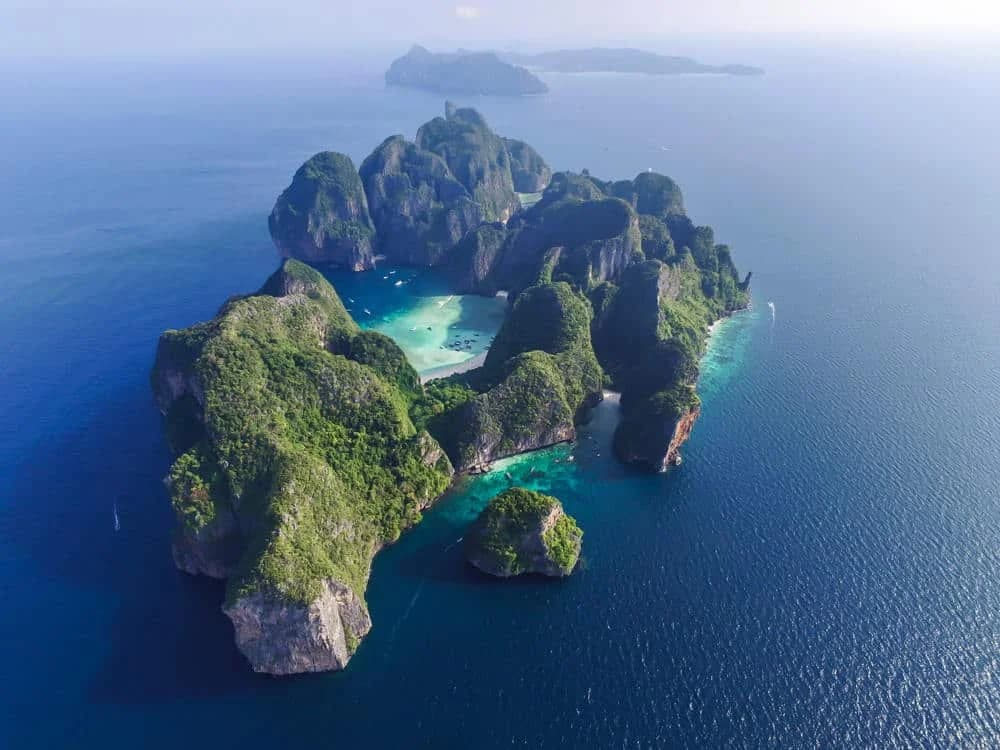
Phi Phi Islands are a group of six, and Ko Phi Phi Don is the largest and most populated of them. Phi Phi Leh, the one with the cliffs everyone photographs, is uninhabited and has no accommodation at all. So the question of where to stay in Phi Phi is really a question about four parts of a single island, each with a different character and a different noise level after dark.
There are no roads and no cars. Everything moves on foot, by longtail boat or by the handcarts that bring luggage up from the pier. That one fact shapes every choice below, because the distance between your room and the pier is measured in walking minutes, not kilometres.
If you want the geography first — which island is which, and how the two bays of Phi Phi Don fit together — our
guide to Loh Dalam Bay and Tonsai covers that ground in detail.
Tonsai Bay: The Arrival Side
Tonsai is where the ferries dock and where most visitors first set foot on the island. The bay faces south toward Phuket and Krabi. Behind the pier the village spreads inland through a grid of narrow lanes carrying dive shops, pharmacies, bakeries, massage shops and the island's small supermarkets.
Staying here means you are five minutes from the pier with your bags, and five minutes from somewhere to eat at any hour. It also means the sound of boat engines starts early, because the first departures leave not long after dawn. Rooms on the lanes a street or two back from the water are noticeably quieter than those on the front.
The bay itself is working water rather than swimming water. Longtails and ferries use it constantly, and the shoreline is a pier and a seawall for much of its length. People stay at Tonsai for the convenience, not the beach.
Loh Dalam Bay: The Other Side of the Same Isthmus
Walk four hundred metres north from the Tonsai pier and you reach Loh Dalam, a wide shallow crescent on the opposite side of the island's narrow waist. This is the swimming bay. The sand is pale, the water is calm, and at low tide it retreats a long way out, leaving a broad flat you can walk across.
Loh Dalam is also where the late-night bars sit, clustered at the eastern end of the beach. Accommodation along the western curve, away from that cluster, gets the same water and much less of the sound. Guests who want to be able to swim before breakfast without taking a boat anywhere tend to choose this side.
Both bays are a few minutes' walk apart, so staying on one does not cut you off from the other. The practical difference is what you hear at two in the morning and what you see when you open the door in the morning.
Long Beach and the Quiet East Coast
Long Beach — Hat Yao on the signs — runs along the south coast about twenty minutes' walk from Tonsai, or a few minutes by longtail. It has a long stretch of sand, a clear view across to Phi Phi Leh, and a reef close enough to the shore that you can snorkel straight off the beach. Resorts here are more spread out and the lanes are quieter.
Further round, the east coast bays such as Loh Bagao and Laem Tong are reached only by boat. These are the most separated places to stay on the island: a handful of resorts, little passing traffic, and a longtail transfer any time you want to reach the village. Guests who choose them are usually after quiet above everything else, and are content to plan their movements around boat times.
Comparing the Areas Side by Side
This table is the short answer to where to stay in Phi Phi. Walking times are from the Tonsai pier.
| Area |
Reaching it from the pier |
Swimming from the shore |
Evening noise |
Suits |
| Tonsai Bay |
On foot, under 5 minutes |
No — working harbour |
Moderate, boat engines from dawn |
Short stays and early ferries |
| Loh Dalam Bay |
On foot, about 5 minutes |
Yes, calm and shallow |
Loud at the eastern end, calm at the western |
Swimming before breakfast |
| Long Beach (Hat Yao) |
20 minutes on foot or a short longtail ride |
Yes, with reef near the shore |
Low |
Snorkelling and a slower pace |
| East coast bays |
Boat only |
Yes, usually a private stretch |
Very low |
Guests who want separation |
Getting to the Island, Step by Step
There is no airport on Phi Phi and no bridge. Every arrival is by sea, and the sequence is the same whichever area you have booked.
- Book your room before you book your crossing, because the area you choose decides whether you need an onward longtail.
- Travel to a departure pier — Rassada in Phuket, or Klong Jilad in Krabi are the usual ones.
- Take the ferry to Tonsai pier; the crossing is roughly two hours from Phuket and shorter from Krabi, depending on the operator and the sea.
- Pay the island's entry fee at the pier on arrival; it is collected from every arriving passenger.
- Walk to your accommodation if you are staying at Tonsai or Loh Dalam, or carry on by longtail for Long Beach and the east coast.
- Agree the longtail fare before you step aboard, as rates vary by distance and by time of day.
- Check the time of the last boat back to the village if you are staying somewhere reached only by water.
Two Sea Tour does not operate the ferries and does not sell crossings, so we quote no fares here. Timetables and prices change by season and by operator, and the pier is the reliable place to confirm them.

What Two Nights Buys You That One Day Does Not
The honest case for staying over is the hours at either end of the day. Between roughly ten in the morning and three in the afternoon the village and the popular bays carry most of the island's visitors. Before and after that window, the same places are markedly quieter.
Staying on the island gives you the early swim at Loh Dalam, the walk up to the viewpoint before the heat, and the evening after the last ferry has gone. It also gives you weather margin: if the sea is rough on your first morning, you still have a second one.
What it costs you is flexibility and money. Accommodation on Phi Phi generally costs more than the mainland equivalent, the choice of food is narrower than in Phuket, and a wet two days on a small island with no cars is a long two days. Our guide to
activities on Phi Phi is worth reading before you commit to a second night, simply to check there is enough there for the time you are booking.
When a Small-Group Day Tour Makes More Sense
Plenty of people decide, after weighing it up, that they would rather sleep in Phuket and visit Phi Phi for the day. That is a reasonable answer, and it is the one Two Sea Tour is built around.
Our Koh Phi Phi day tour leaves Boat Lagoon Marina at 6:00 AM, with hotel pickup from about 5:00 AM and a return to your hotel at around 3:00 PM. The early start is the point: it puts the boat at the first stops before the bulk of the day's traffic arrives. We carry a maximum of 18 adults and average 14, which is a smaller group than most join-in boats on the same route.
The tour is ฿5,310 for an adult aged 12 and over and ฿3,150 for a child aged 4 to 11, with infants under 4 carried free. The fare is all-inclusive: hotel pickup from along the main Phuket tourist coast, a light breakfast, the buffet lunch, snorkelling gear for every guest and national park entrance fees. VAT and the booking fee are absorbed, so the price shown is the price paid. Cancellation is free up to 24 hours before departure, and once 18 adults are booked that day is closed. Two Sea Tour holds TAT licence 34/02111. Rates checked on the booking page, 18 October 2026.
If you are comparing operators rather than deciding between staying and day-tripping, our post on
choosing a Phi Phi speedboat tour from Phuket sets out what to compare, and the
hour-by-hour account of the day shows what actually happens between the two piers.
Booking Into High Season: What the Next Few Weeks Look Like
Interest in Phi Phi is climbing as the monsoon ends. Google Trends data for Thailand, read on 18 October 2026, puts search interest in “phi phi” at 47 for the week of 18 October, against 24 four weeks earlier — close to double in a month. The same series peaked at 99 in the second week of November last year, so the curve we are on now is the usual run-up to high season.
For anyone working out where to stay in Phi Phi over the coming weeks, that has a practical edge. Rooms in the village and on Long Beach are booked further ahead from November onward than they are in October, and the quieter east-coast resorts, which have fewer rooms to begin with, fill earliest. Sea conditions also settle through this period, which makes the crossing more comfortable and makes longtail transfers to the east coast more reliable.
The reverse is true of the shoulder weeks we are in now: more availability, lower rates, and a higher chance of a grey day.
What Two Sea Tour Does and Does Not Offer
To be clear about our own role: Two Sea Tour runs speedboat day trips from Phuket. We do not book accommodation on Phi Phi, we do not run the ferries, and we do not drop guests on the island to stay. Everything above about where to stay in Phi Phi is written to help you plan, not to sell you a room.
We also do not run to the Similan Islands, which are too far north for a day trip from our marina. Our snorkelling stops are on the Phi Phi route, at the reefs the boat reaches between Maya Bay and Bamboo Beach. Dolphins are sometimes seen on the crossing, though nobody can promise them.

Planning Your Phi Phi Days
Pick your area for what you want from the hours outside the middle of the day: the pier at Tonsai, the swimming at Loh Dalam, the reef at Long Beach, or the separation of the east coast. Book the room first and the crossing second. And if the answer turns out to be that one good day is enough, that is the trip we run.
You can see the current Phi Phi itinerary and rates on the
Phi Phi Island speedboat tour page, or ask us anything first — our
cancellation terms are 24 hours, so there is room to change your mind. Call +66 81 787 7702 or message +66 62 979 9974 on WhatsApp and you will reach the people who run the boats.